QUIC
Transitioning to QUIC
History
In the early days of computer networks, devices simply communicated with each other by sending files or other data over protocols like FTP, Gopher, or Telnet connections for remote access. This worked because the files were not interlinked. At CERN, there were many scattered documents that were hard to work with. Around 1990, Tim Berners-Lee at CERN proposed an idea to handle all those documents properly. His proposal included:
- HTML - the language we would use to write these interconnected files
- HTTP - the protocol we would use to work with these files, request or receive them
- URL - the addressing system for these linked files
This was the first version of HTTP. It was so simple, it was called the “one-line protocol” or HTTP/0.9 (dubbed later).
The first web server was CERN httpd running on a NeXT Workstation that only supported GET requests and only responded with raw HTML. The browser used to access this was called the WorldWideWeb browser (yep, that’s where the name comes from).
ARPANET was introduced before all this. The Internet did exist in some form, but it was only widely recognized around the 1980s. TCP/IP was adopted as the internet standard in 1983. So, HTTP/0.9 worked over TCP/IP.
HTTP did not reinvent anything; it worked on the existing TCP/IP stack.
This first version did not have headers like those we see in packets now. HTTP/1.0 introduced headers, status codes, and MIME types. HTTP/1.1 introduced persistent connections, pipelining, and chunked transfer encoding (RFC 2616—now RFC 9112).
The introduction of HTTP was a major shift in networking. Previously, machines just sent files to one another, but suddenly you could get any document as long as it was on a server you could connect to.
Naturally, as the first version of its kind, there were quite a few problems:
- Head of Line Blocking: Even with multiple requests, later requests had to wait on earlier ones.
- Too many TCP connections: To achieve parallelism, browsers opened multiple TCP connections – more overhead.
- Lack of any priority system or multiplexing: Important resources like CSS or JS files were treated the same as any other.
- Repetitive Headers: Each request included all the same headers.
As time passed, a lot of websites were getting heavier with pictures, scripts, styles, etc. that were hard for HTTP/1.x. The developers got hacky (domain sharding, inlining, etc.) to get around these limitations of HTTP/1.x
Google created SPDY around 2009 to experiment with multiplexing, header compression, prioritization, etc. This kind of paved the way forward to HTTP/2.
In 2015, the RFC 7540 specification for HTTP/2 was published and it soon gained traction across web traffic.
Improvements in HTTP/2 included:
- Binary Framing: Messages were encoded in frames, each with stream IDs and types.
- Multiplexing: Multiple streams (requests/responses) can exist in a single TCP connection.
- Header Compression: using HPACK, with modifications to avoid security issues.
- Request Prioritization: The client can specify important files, and the server can send them earlier.
- Server push: Servers can send files if they anticipate the need.
- Reuse of Connections: One TCP connection per origin was enough, thanks to multiplexing.
This was a great improvement, but it also had its caveats:
- It still ran over TCP; concurrency was possible with multiplexing, but packet loss and congestion in one connection degraded throughput even with multiple streams.
- Browser and server implementations varied, and some modifications hurt more than they helped.
- Server push was hard to configure properly and could waste bandwidth if not done correctly.
- Added complexity: latency penalties due to TCP, TLS handshakes, etc.
HTTP/2 had TCP and TLS integrated separately, which led to high RTT. Also, as mobile devices grew, there was a need to tackle higher packet loss, reduce latency, and deal with varying connectivity.
Google started working on QUIC to integrate TLS more tightly and to use UDP instead of TCP, addressing packet loss and connection migration. It started as an experimental protocol at Google, initially named gQUIC. Google used this internally for some services to test and improve it. Slowly, IETF picked up QUIC and worked on standardizing it. The IETF QUIC diverged from Google’s initial implementation to improve performance, security, and other things. So, the QUIC protocol we see now is quite different from Google’s original version.
HTTP/3 was already in development over QUIC around 2021 and it was standardized in 2022 (RFC 9114).
That was a lot of history. whew!
Before we dive into QUIC, let’s briefly look at UDP and TCP and try to understand what we’re trying to solve with each of them.
how does TCP work?
TCP powers most of today’s internet traffic. It was created in the 1970s, when the primary goal for transmission was reliability. The hardware was not as developed, so there was a lot of packet loss, corruption, etc. TCP was made to deal with these issues.
It primarily aimed to provide reliable data transfer, ordered delivery, flow control (to ensure the sender doesn’t overwhelm the receiver), and congestion control (to avoid overwhelming the network).
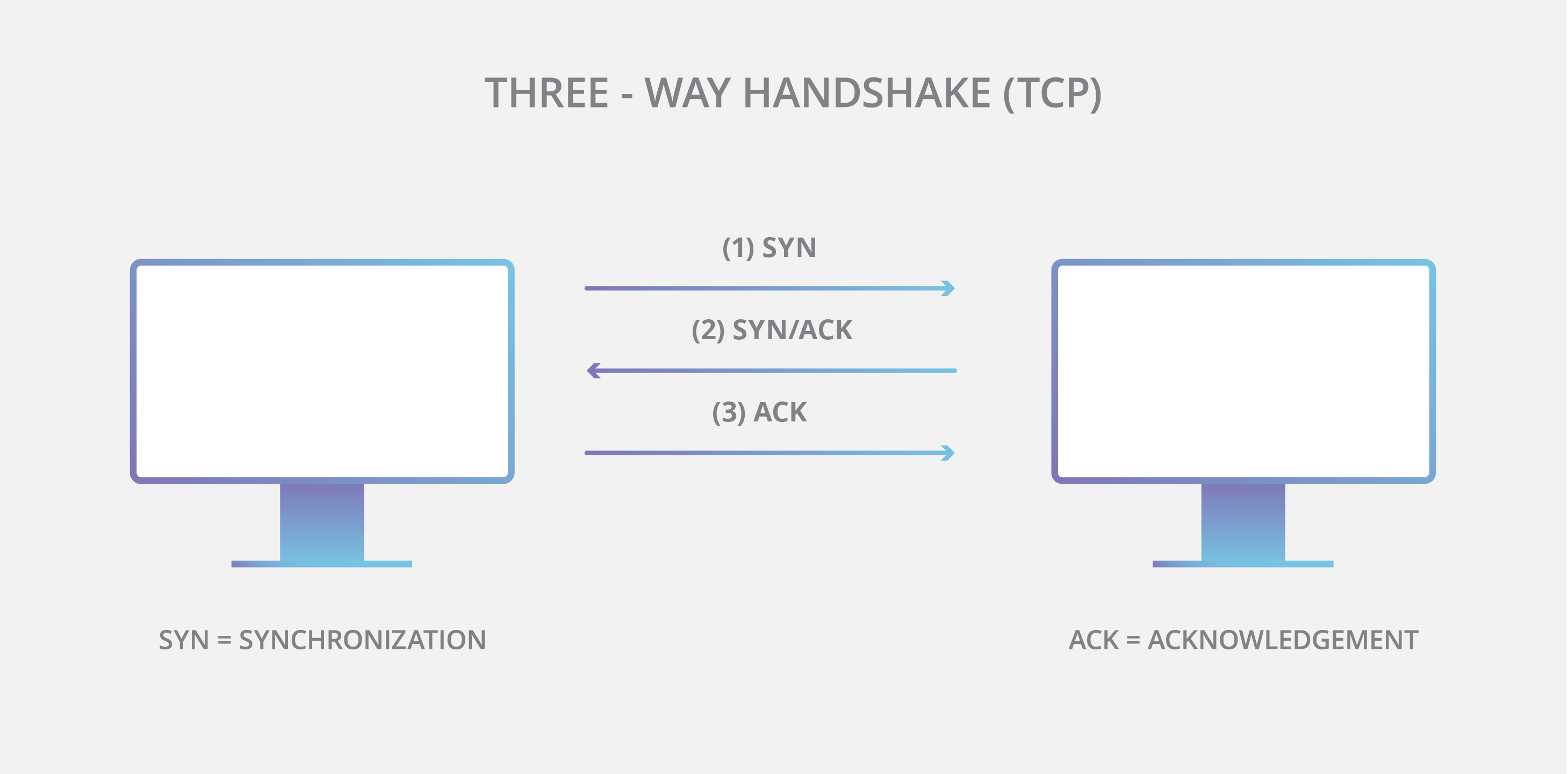
This uses a 3-way handshake to establish a connection. The sender sends a SYN packet, the receiver responds with SYN-ACK and then the sender sends an ACK back. This establishes a connection.
This means at least one full RTT (Round Trip Time) before any data can be sent.
The data transfer occurs as a stream of bytes with each byte having a sequence number. The receiver keeps sending back acknowledgements (ACKs) for the received bytes. If the sender doesn’t receive an ACK within a certain time limit, it resends the packets. Hence, “reliable”. The send rate is dependent on the ACKs received – “flow control”. If the network is congested, packets may be dropped, leading to retransmissions and reduced send rate – “congestion control”.
When the connection is no longer needed, it is terminated using a 4-way handshake. One side sends a FIN packet, the other side responds with an ACK, then sends its own FIN, and finally the first side responds with an ACK. For reading more about TCP, you can look into RFC 793.
This worked brilliantly and still does in most cases. But as the internet grew, we needed more speed, lower latency, and better packet handling, especially with mobile devices.
TCP has head-of-line blocking issues. If a packet is lost, all subsequent packets have to wait until the lost packet is retransmitted and received. This can lead to significant delays, especially in high-latency networks. Also, your connection would be tied to your IP address. Suppose you change from your home Wi-Fi to mobile data; your IP changes, and you have to establish a new connection.
There is another issue. TCP is deeply integrated into the OS kernels. This means any changes made to TCP would need OS updates. Now, this might seem trivial but there are a lot of devices out there and we would need change the server implementations, each mobile device OS, your PC OS, etc. separately. The data flow in the internet involves a lot of intermediate devices that would also need to understand these changes. This would take decades to roll out any major changes. TCP surely has evolved over time but not as fast as we would want it to.
how does UDP work?
This is one of the simplest protocols out there. There are no handshakes here, no retransmissions, no ordering, no congestion or flow control. We just send the packets! Applications that use UDP have to deal with all of this themselves. Each UDP packet has:
- Source Port
- Destination Port
- Length
- Checksum
- Data
That is just 8 bytes of headers compared to around 20 bytes in TCP headers. Hence, the OS doesn’t wait for any acknowledgements or anything, it just sends the packets immediately. UDP treats data as discrete messages.
UDP supports broadcasting and multicasting, making it useful for gaming, streaming, etc. This also gives developers the freedom to implement their own custom congestion control, etc.
Since UDP doesn’t enforce strict reliability or connection management, we can reimplement these behaviors in user space, allowing for faster iterative development.
QUIC
QUIC - Quick UDP Internet Connections
This is a transport layer network protocol designed by Google and later standardized by IETF. It is built on top of UDP and aims to provide features similar to TCP but with lower latency and better performance.
QUIC builds upon UDP to implement reliability, congestion control, multiplexing, and connection migration. It deeply integrates with TLS 1.3 for security.
HTTP/2.x also had TLS integrated, but it was separate from TCP, which increased the RTT.
Let’s discuss these features in detail.
Connection Establishment
In HTTP/2.x, there was one round trip for the TCP handshake and another for the TLS handshake. This meant at least 2 RTTs before any data could be sent. Yes, there was also a version called TLS False Start that allowed sending data after the first round trip, but it was not widely adopted due to security concerns. This assumed that the client and server had previously connected and had cached information, allowing them to establish a new connection without a full handshake. So, practically, we still had to wait for 2 RTTs for the first connection and 1 RTT for subsequent connections.
The TLS handshake before TLS 1.3 looked like this:
1
2
3
4
Client ----> Server : ClientHello
Client <---- Server : ServerHello + Certificate + Key Exchange
Client ----> Server : Finished
Client <---- Server : Finished
In TLS 1.3, this was reduced to:
1
2
Client ----> Server : ClientHello
Client <---- Server : ServerHello + Certificate + Key Exchange + Finished
%%{
  init: {
    "theme": "base",
    "themeVariables": {
      "background": "#1c1c1c", /* Matches a dark site background */
      "textColor": "#e0e0e0", /* Light text for readability */
      "actorTextColor": "#80deea", /* A vibrant teal for actors */
      "lineColor": "#4dd0e1", /* A slightly different teal for lines */
      "noteBkgColor": "#004d40", /* Dark teal note background */
      "noteTextColor": "#e0e0e0", /* Light text on notes */
      "participant": "#80deea"
    }
  }
}%%
sequenceDiagram
    participant C as Client
    participant S as Server

    %% --- TLS 1.2 Handshake (2 RTT) ---
    rect rgba(255, 127, 80, 0.1)
        Note over C,S: TLS 1.2 Handshake<br>(requires 2 Round Trips)

        C->>S: ClientHello
        Note right of C: I want to talk,<br>here are my specs.

        S-->>C: ServerHello, Certificate, ServerKeyExchange, ServerHelloDone
        Note left of S: OK, let's use these specs.<br>Here's my ID and key.

        Note over C,S: --- Round Trip 1 Complete ---

        C->>S: ClientKeyExchange, ChangeCipherSpec, Finished
        Note right of C: Here is my secret.<br>Let's start encrypting!

        S-->>C: ChangeCipherSpec, Finished
        Note left of S: Acknowledged.<br>Encryption begins.

        Note over C,S: --- Round Trip 2 Complete (Handshake Finished) ---
    end

    %% --- TLS 1.3 Handshake (1 RTT) ---
    rect rgba(77, 208, 225, 0.15)
        Note over C,S: TLS 1.3 Handshake<br>(only 1 Round Trip)

        C->>S: ClientHello + Key Share
        Note right of C: I want to talk. I'll guess your key<br>method and send a secret now.

        S-->>C: ServerHello + Key Share, EncryptedExtensions, Certificate, CertVerify, Finished
        Note left of S: Your guess was right! Here is my ID,<br>my secret, and my confirmation. We're done.

        Note over C,S: --- Round Trip 1 Complete (Handshake Finished) ---

        C->>S: Application Data
        Note right of C: Client can send encrypted<br>data immediately.
    end
The question was: if we have connected securely before, why not use that cached info again? When you complete a TLS 1.3 or QUIC handshake for the first time, the server issues a session ticket or PSK (Pre-Shared Key) to the client. The client stores this information. When it wants to reconnect, it sends a ClientHello with the PSK. The server checks if it recognizes the PSK and if valid, it can skip the full handshake and proceed directly to secure communication. The first data packet from the server carries both handshake info and encrypted application data.
QUIC combines the TCP handshake and TLS handshake into a single process. So 1 RTT is enough to establish a secure connection and send data. If the client reconnects to the server, it can achieve 0-RTT since it has cached information from previous connections. This achieves true 0-RTT for subsequent connections.
%%{
  init: {
    "theme": "base",
    "themeVariables": {
      "background": "#1c1c1c", /* Matches a dark site background */
      "textColor": "#e0e0e0", /* Light text for readability */
      "actorTextColor": "#80deea", /* A vibrant teal for actors */
      "lineColor": "#4dd0e1", /* A slightly different teal for lines */
      "noteBkgColor": "#004d40", /* Dark teal note background */
      "noteTextColor": "#e0e0e0", /* Light text on notes */
      "participant": "#80deea"
    }
  }
}%%
sequenceDiagram
    participant Client
    participant Server

    rect rgba(77, 208, 225, 0.15)
        Note over Client,Server: QUIC 1-RTT Handshake

        Client->>Server: Initial Packet [CRYPTO(ClientHello)]
        Note over Client,Server: Packets are protected with Initial Keys

        Server-->>Client: Initial Packet [CRYPTO(ServerHello)]
        Server-->>Client: Handshake Packet [CRYPTO(EncryptedExtensions, Cert, etc.)]
        Note over Client,Server: Packets are protected with Handshake Keys

        Client->>Server: Handshake Packet [CRYPTO(Finished)]
        Note over Client,Server: 1-RTT Keys are now established for both sides

        loop Encrypted 1-RTT Communication
            Client->>Server: 1-RTT Packet [Application Data]
            Server-->>Client: 1-RTT Packet [Application Data]
        end
    end
0-RTT Cryptography
When a normal TLS 1.3 handshake happens, both client and server derive a master secret from the key exchange.
HKDF - HMAC Based Key Derivation Function: HKDF(handshake_secrets) – RFC 5869 and RFC 8446.
From this master secret, the server creates a resumption secret and sends it to the client as part of the session ticket. The ticket is opaque to the client (the client cannot read its contents).
When the client wants to reconnect, it sends a ClientHello with the resumption secret. The server checks if it recognizes this secret and if valid, it derives the same master secret using the resumption secret. Both sides derive the early traffic keys using HKDF and the client can start sending 0-RTT encrypted data immediately. Meanwhile, the normal TLS handshake also continues in the background to establish fresh keys for future communication.
Here, the first data packet uses the older keys. If an attacker had recorded the previous session, they could replay this packet to the server—a replay attack.
Multiplexing and Streams
In TCP, if a packet is lost, all subsequent packets have to wait until the lost packet is retransmitted and received. This is called head-of-line blocking. This can lead to significant delays, especially in high-latency networks. There was no prioritization either, we could not send important files like CSS or JS earlier than others.
%%{
  init: {
    "theme": "base",
    "themeVariables": {
      "background": "#1c1c1c", /* Matches a dark site background */
      "textColor": "#e0e0e0", /* Light text for readability */
      "actorTextColor": "#80deea", /* A vibrant teal for actors */
      "lineColor": "#4dd0e1", /* A slightly different teal for lines */
      "noteBkgColor": "#004d40", /* Dark teal note background */
      "noteTextColor": "#e0e0e0", /* Light text on notes */
      "participant": "#80deea"
    }
  }
}%%
sequenceDiagram
    participant Browser
    participant Server
    Browser->>Server: Request 1 (A)
    Browser->>Server: Request 2 (B)
    Browser->>Server: Request 3 (C)
    Note over Server,Browser: Packet A is lost!
    Server-->>Browser: Response 2 (B)
    Server-->>Browser: Response 3 (C)
    Note over Browser,Server: Must wait for Packet A to be resent<br>before processing B and C.
HTTP/2 tried to solve multiplexing at the application layer but it still used TCP underneath, so it was limited by TCPs (transport layer) Head of Line (HoL) Blocking.
QUIC solves this by using UDP as its foundation. Since UDP doesn’t guarantee order or reliability, QUIC can implement its own lightweight reliability and retransmission per stream.
In QUIC, there are multiple streams within a single connection. Each stream can be independently managed. If a packet in one stream is lost, it does not block the delivery of packets in other streams. Meaning, we can deliver important files without waiting for lost packets in other streams to be retransmitted. We get parallel, isolated data flows in the same UDP socket. Here, the packet loss handling is done per stream, not per connection.
%%{
  init: {
    "theme": "base",
    "themeVariables": {
      "background": "#1c1c1c",
      "textColor": "#e0e0e0",
      "actorTextColor": "#80deea",
      "lineColor": "#4dd0e1",
      "noteBkgColor": "#004d40",
      "noteTextColor": "#e0e0e0",
      "participant": "#80deea"
    }
  }
}%%
flowchart TB
    subgraph TCP_HTTP2["HTTP/2 over TCP"]
        direction TB
        A[Stream 1] & B[Stream 2] --> C[TCP Layer: In-order Delivery] --> D[Server App]
        C --> E["<b>HoL Blocking:</b><br>Packet loss in one<br>stream stalls all others"]:::warn
    end

    subgraph QUIC_HTTP3["HTTP/3 over QUIC (UDP)"]
        direction TB
        A2[Stream 1] & B2[Stream 2] --> C2[QUIC Layer: Per-stream Reliability] --> D2[Server App]
        C2 --> F["<b>No HoL Blocking:</b><br>Loss in one stream<br>doesn’t block others"]:::ok
    end

    %% Class definitions optimized for a DARK background
    classDef warn fill:#5a1e1e,stroke:#c83838,color:#f0e0e0;
    classDef ok fill:#1e5a39,stroke:#38c878,color:#f0e0e0;
Congestion Control and Loss Recovery
TCP works nice when managing congestion – it slows down when it detects packet loss and speeds up when it doesn’t. Now this is fine, but it does come with its flaws:
- TCP has limited feedback. It relies on ACKs to determine delay. The retransmitted packets have the same byte range and sequence numbers, this makes it difficult to distinguish between new and old data – causes uncertainty in RTT estimation and congestion control.
- TCP’s congestion control algorithms are not very adaptive to varying network conditions, especially in high-latency or lossy networks. This can lead to suboptimal performance.
- Inflexible congestion control: TCP’s congestion control mechanisms are built into the kernel, making it difficult to experiment with or deploy new algorithms without OS updates.
QUIC addresses these issues by having things in user-space. We can plugin in algorithms like BBR, CUBIC, Reno, etc. and tune things without OS updates. Rapid iteration for the win!
In QUIC, every packet has a unique packet number. This removes the ambiguity in distinguishing between new and old data. QUIC also uses ACK frames that can acknowledge multiple packets at once, and include ACK delay – providing more granular feedback about which packets were received successfully and which were lost. This allows for more accurate RTT estimation and better congestion control.
Loss detection would be done with packet number gaps, timeouts, etc.
This results in more consistent latency and throughput, hence less jitter.
Connection Migration
TCP connections are tied to IP addresses. You would’ve seen this when you setup TcpStreams in any programming language. If your IP changes, you have to establish a new connection. This is a problem for mobile devices that switch between networks (WiFi to cellular). Establishing a new connection means doing the entire handshake process again along with the TLS handshake too!
In QUIC, connections are identified by Connection IDs rather than IPs. During the handshake, both the client and server exchange CIDs. Each endpoint can issue new CIDs to others for future path migration.
Suppose you change your IP addresses. The server sees this:
1
2
Old path: 192.168.1.22:50000 → 142.250.190.78:443
New path: 10.24.90.11:53012 → 142.250.190.78:443
The server will not trust this as this could a spoofed IP, old path might still be alive, congestion control metrics might be different, etc. So we need to validate it. When the client sends packets from a new IP address, the server doesn’t trust it immediately. It sends a PATH_CHALLENGE frame to the new address. The client must respond with a PATH_RESPONSE frame. This verifies that the client controls the new address. Once verified, the server updates its routing to use the new IP for that connection.
Spoofed IP is something like you modify the IP address in the packet headers to appear as if they are going from someone else. You don’t have the actual IP or anything you just wrote it. The server could easily validate by requesting an echo from the new IP. That’s exactly what is going on here.
If you think about Man-in-the-Middle attacks, this could be a problem. An attacker could intercept your packets and send their own PATH_CHALLENGE to the server. The server would then send a PATH_RESPONSE to the attacker, who could then forward it to you. But this means the attacker is already intercepting and modifying traffic, no transport protocol can prevent that. You data is still safe though thanks to TLS 1.3.
TLS Integration
In TCP + TLS, they are separate layers. TCP handles the transport and TLS handles the security. This introduced additional RTTs and complexity.
in QUIC, most of the packet header and payload is encrypted using TLS 1.3. This means that QUIC packets are protected from eavesdropping and tampering. The encryption is done at the transport layer itself, reducing the number of round trips needed for secure communication. Since, a lot of the connection is encrypted, it is harder for middleboxes (firewalls, routers, etc.) to interfere with the connection. QUIC packets appear as regular UDP packets to these middleboxes, reducing the chances of connection issues due to misconfigured or outdated middleboxes. This resistance to protocol ossification is a key design goal of QUIC.
HTTP/3
This is the latest version of the HTTP protocol that runs over QUIC. It inherits all the benefits of the QUIC as described above. It uses the same request/response model as HTTP/1.x and HTTP/2 but with improved performance and security. So here we get:
- Reduced Latency: 1-RTT connection establishment and 0-RTT for subsequent connections.
- Multiplexing without HoL Blocking: Independent streams within a single connection.
- Improved Congestion Control: More accurate RTT estimation and adaptive algorithms.
- Connection Migration: Seamless switching between networks without dropping connections.
- Built-in Security: TLS 1.3 integration for encrypted communication.
- Drop-in Replacement: Designed to be a drop-in replacement for HTTP/2, making it easier to adopt.
QUIC and HTTP/3 don’t really re-invent anything new, they are built upon existing concepts but with more granular fine-tuning. At the time of writing this, HTTP/3 is supported by all major browsers and many CDNs and web servers. Around 30-40% of web traffic is now over HTTP/3.
Thoughts?